Tank Showdown

Click here to see my DEV.AI project

rHomescreen Homescreen

Description

Play Tank Showdown Here!

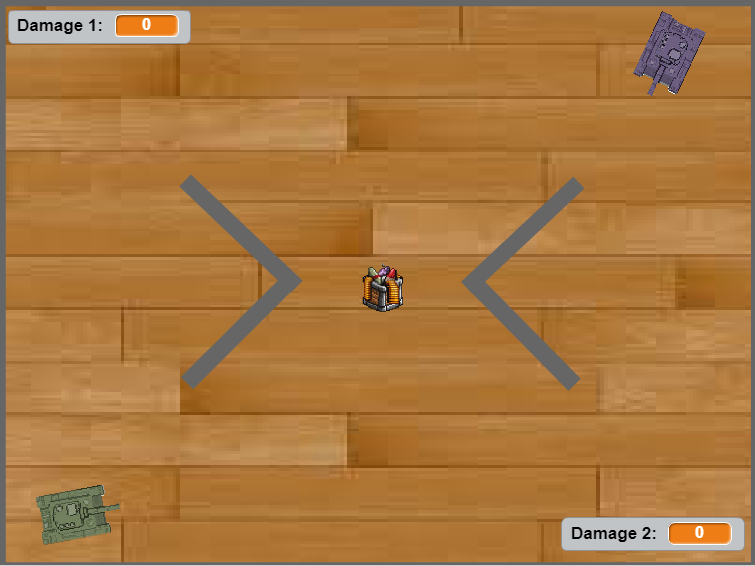
This is my very first Scratch Game that I made as a project! The scoring system that I used is based on a damage indicator. The first person wins. I added an element of random number generators via the crate that respawns randomly throughout the game. As the game is played, the players recieve more access to the crate and thus it becomes increasingly harder to avoid being hit from fast bullets.

Reflection

I created this type of game using inspiration from an Ipad game I used to play. I decided to make my own version of the game with new improvements according to my likings. I encountered many successes during the making of my game. Two included the code for moving the sprites and the discovery of how to use the random blocks. Along with success, there came a few obstacles. Obstacles I faced while programming the game were trouble with bullet cloning and sprite interactions. To overcome these obstacles, I conducted reseach and recieved knowledge on how to use the cloning and broadcast blocks. I am quite glad with the result of my game, but if I had more time to work I would have added more powerups.
Code More Tools

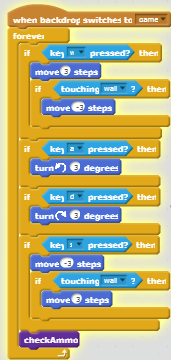
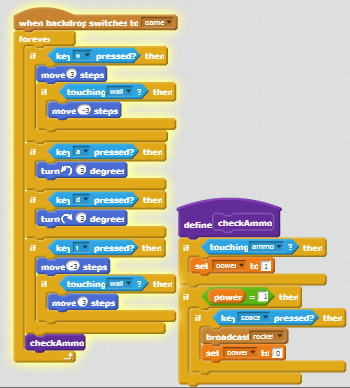
Above is my move algorithm that is crucial for controlling the movement of the tanks. This is an algorithm because it is constantly performing loops that checks if the control keys are pressed. If one of the control keys are pressed, then it will turn or move 3 steps depending on the key. If the sprite runs into a wall, then it will be set back 3 steps. At the end of the algorithm is a custom block that checks if the player has ammo. If the player has ammo, power will be set to 1 and the player's next shot will be a fast rocket.
DEV.AI


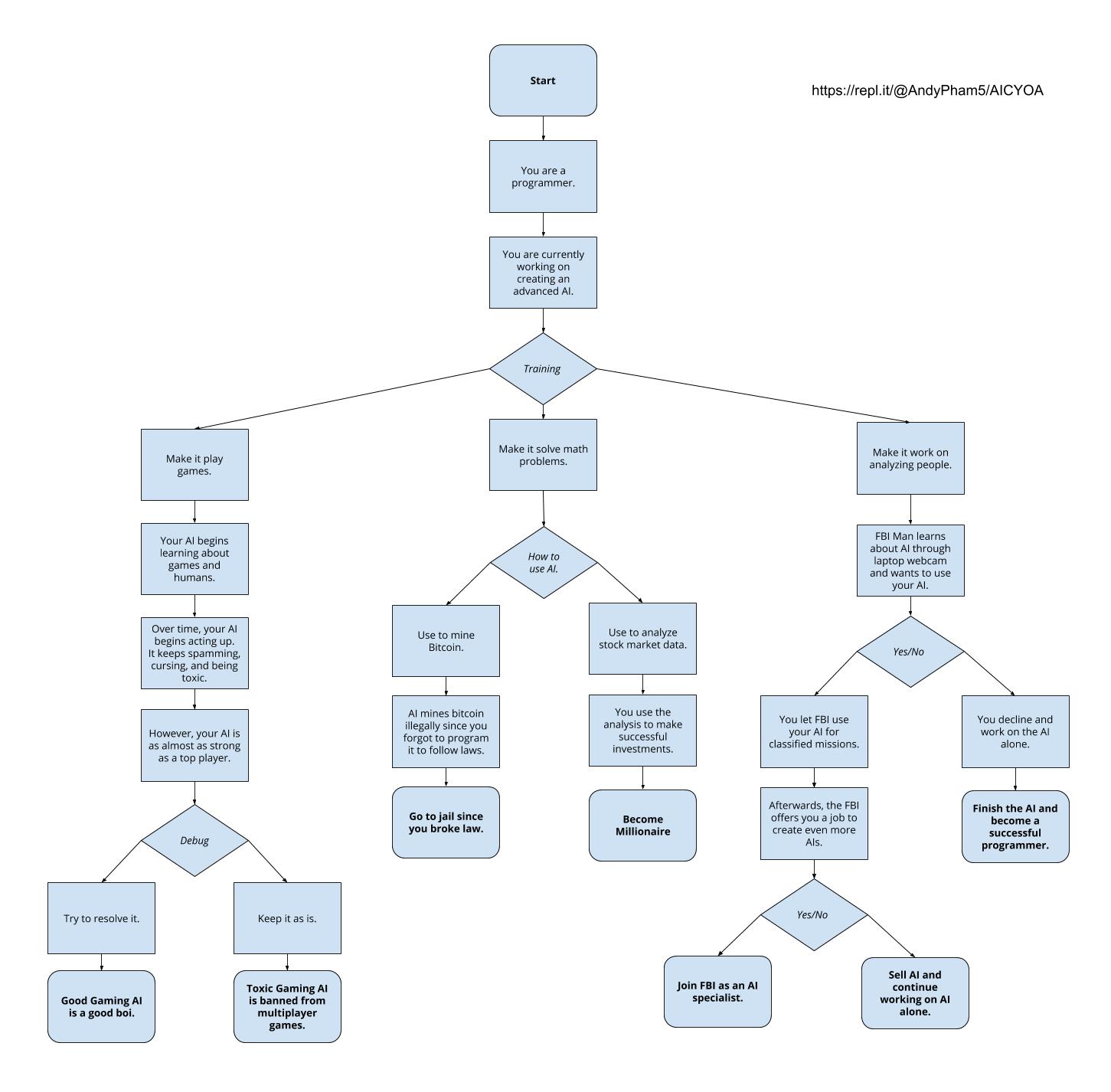
DEV.AI is a choose your own adventure game that I programmed with Andy, my partner. Players get to view the story in the main characters perspective and even get to choose actions of the character. The main character is constructing an AI and needs help deciding how to purpose it; based on the player's choices for the main character, they will recieve a unique ending.


When constructing this game, Andy and I went through many incremental and iterative processes. For our incremental processes, we decided to work on each path according to the order in which the player chose, meaning that we designed each path by advancing into the ending one player decision at a time. For our iterative processes, I had to re-run the code many times to fix spacing and line skipping errors. One difficulty I faced while designing our game was spotting indentation, spacing, and skipping error. Once in a while, I would encounter errors in the way words were spaced, cut off, or positioned. This would be a problem to the players as the errors would cause more difficulty in reading the storyline, which is a huge part of the game. They were hard to spot in the code, so I resolved the issues by having my partner run the story on his moniter and checking along with the code on my moniter as the story progressed. That way, fixing the issues was much faster and efficient. My partner and I organized the scenes or our story into functons, which was a form of abstraction because it shortened the scene into a function name rather than the many lines of code. By organizing the scenes into functions, were not forced to hand replicate the code of each scene everytime we needed to duplicate the scene for testing; instead, we only had to refer to the function name which was an advantage since it would save us time. Along with Andy and I, there were other students in my AP Computer Science Principles class made a choose your own adventure game. One game my partner and I particularly liked was "Stranded" because we found the plot of being stuck on an island interesting.